
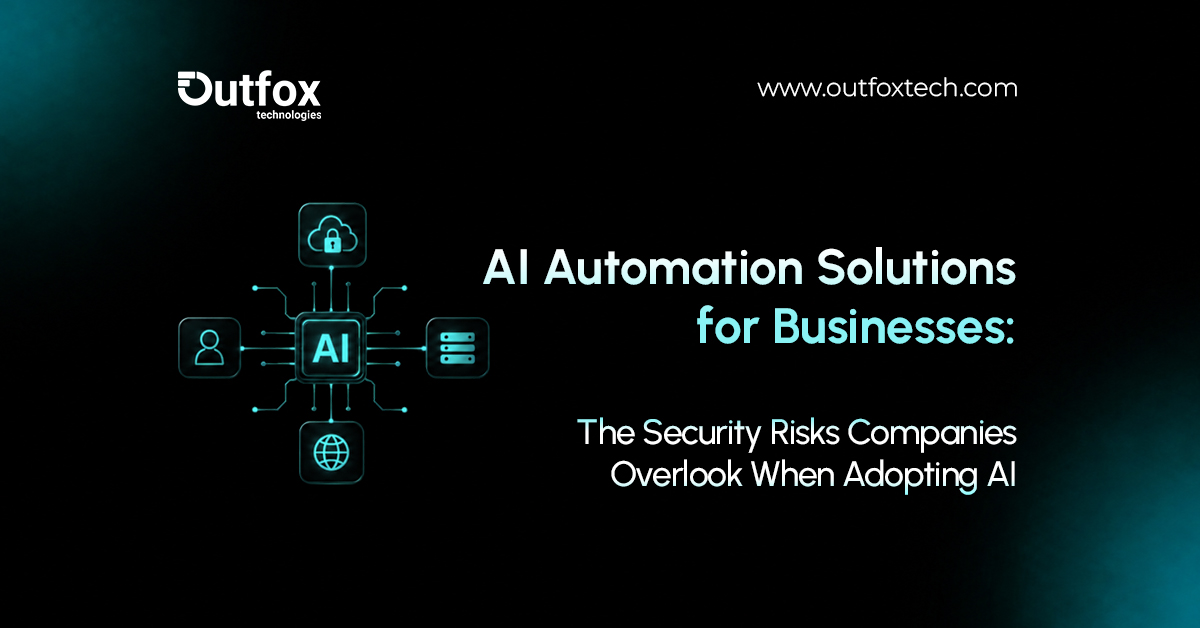
Artificial intelligence is developing into a key part of the modern day corporate environment at a fast pace. With the help of various capabilities like bots, predictive analysis, automation of processes, and more, AI is changing the way companies work. Some examples of areas that companies aim to achieve through AI automation solutions for businesses include efficiency, innovation, and reduction of costs.
Nevertheless, an important aspect of implementing AI that is often neglected by most companies is the aspect of security.
The implementation of AI can be beneficial for businesses, although it can also pose several threats which might not have been accounted for by existing cybersecurity systems. The urgency to implement artificial intelligence systems can lead companies to ignore the potential threats in their system..
Security Risks in AI Automation Solutions for Businesses
Conventional software programs follow predetermined guidelines and frameworks. In contrast, AI systems constantly learn from data, communicate with other sources, and use sophisticated models to inform their decisions.
A greater assault surface is produced by this dynamic nature.
Businesses that engage in AI software development services frequently place a strong emphasis on performance and usefulness. When businesses are under pressure to release AI-driven products as soon as possible, security concerns could be viewed as secondary issues.
Sensitive company data, client information, and private intellectual property may be exposed to hazards in this ecosystem that were never thoroughly evaluated during deployment.
Risk #1: Poor Data Governance and Sensitive Data Exposure
Data is crucial for AI to be able to function properly. However, most companies do not realize how much confidential information enters the AI environment in such scenarios.
Customer records, financial information, employee data, healthcare information, and confidential business documents are often used to train or enhance AI models.
In the absence of strong governance frameworks, organizations may unintentionally disclose:
- Personally identifiable information (PII)
- Financial records
- Intellectual property
- Internal communications
- Customer behavior data
One of the most common mistakes made is thinking that when one uploads their data to AI-based technologies, their data will remain entirely confidential. The way in which the technology manages the data could potentially make one’s business susceptible to non-compliance. For this reason, before deploying any AI-based solutions, one must have sound data policies in place.
Risk #2: Unsecured Third-Party AI Integrations
Many businesses adopt AI through third-party platforms rather than building solutions internally. While this accelerates implementation, it also introduces additional security concerns.
Every integration creates a new potential entry point for cyber threats.
Organizations utilizing digital transformation services often connect AI tools with:
- CRM platforms
- ERP systems
- Customer databases
- Cloud storage solutions
Communication tools
The failure to implement authentication, monitoring, and security measures means that criminals will have access to critical organizational systems. Security reviews by vendors must become an integral part of every AI strategy. Organizations need to know how their vendor manages storage, encryption, compliance, and incident management.
Risk #3: Shadow AI Within Organizations
The emergence of shadow AI automation solutions is one of the security issues that is expanding the fastest.
Without IT permission, workers are increasingly using public AI technologies to finish jobs, create reports, write code, or analyze data. This raises serious governance issues even though it might increase productivity.
For instance:
- Confidential documents may be uploaded by staff members into public AI tools.
- AI-generated code may be used by developers without security verification.
- Unofficial platforms might access client information.
There is likely to be rapid progress in shadow AI beyond the scope of corporate legislation.
Monitoring systems, employee training programs, and clear AI guidelines are all required.
Risk #4: Model Manipulation and Prompt Injection Attacks
AI models are vulnerable to unforeseen influences.
Prompt injection tactics are being used more and more by cybercriminals to alter AI behavior. These assaults aim to produce unexpected results, reveal hidden information, or override system commands.
Companies that use AI systems that interact with customers are particularly vulnerable.
A manipulated AI assistant could:
- Reveal confidential information
- Generate harmful content
- Provide inaccurate recommendations
- Bypass established security controls
Companies working with machine learning development services should incorporate security testing into every phase of model development and deployment.
AI security cannot be treated as a one-time checklist. Continuous monitoring and testing are essential.
Risk #5: Insecure Cloud Infrastructure
As a result of their processing demands, many AI workloads rely significantly on cloud systems.
Despite the benefits of the flexible and scalable nature of cloud platforms, one of the main reasons why data leaks occur is configuration errors. In cases when organizations depend on cloud hosting services, their security does not become a priority over performance.
- Common issues include:
- Misconfigured storage buckets
- Weak access permissions
- Unencrypted databases
- Inadequate monitoring systems
- Poor network segmentation
Businesses should adopt security-first cloud architectures supported by reliable managed hosting services that include proactive monitoring, backup strategies, and threat detection capabilities.
Risk #6: Lack of Access Controls
AI systems frequently connect multiple departments, data sources, and business applications.
Without proper access management, employees may gain visibility into information beyond their job responsibilities.
This creates both internal and external risks.
Security best practices should include:
- Role-based access control (RBAC)
- Multi-factor authentication
- Activity logging
- Privileged account monitoring
- Regular permission audits
As organizations expand through scalable application development, maintaining strict access governance becomes increasingly important.
Risk #7: Compliance and Regulatory Challenges
AI regulations continue to evolve across industries and regions.
Many organizations adopt AI automation solutions without fully understanding how regulations apply to their operations.
Compliance requirements may affect:
- Data collection
- Data storage
- Automated decision-making
- User consent
- Cross-border data transfers
Ignoring compliance requirements may result in fines, harm to one’s reputation, and mistrust from clients.
Compliance and legal teams should be involved early in the development process when businesses are developing custom web applications using AI components.
Instead of being viewed as distinct endeavors, security and compliance must collaborate.
Risk #8: Vulnerabilities in AI-Powered Applications
AI capabilities are increasingly embedded into business software.
AI functionality adds complexity whether businesses engage in enterprise platforms, customer portals, or web application development.
Among the possible weaknesses are:
- API security weaknesses
- Data leakage
- Insecure integrations
- Unauthorized model access
- Insufficient input validation
The software lifecycle should incorporate secure development approaches.
This is particularly important for companies developing AI-powered platforms through cross-platform and business mobile app development projects, because user data moves across many settings and devices.
Building a Secure AI Adoption Strategy
One thing unites the most effective AI implementations: security is incorporated into the plan from the start. Organizations should address cybersecurity as an essential part of AI transformation rather than as a last step.
A robust architecture for AI security should comprise:
Establish Clear Governance Policies
Define how AI tools can be used, what data can be processed, and who has authorization to access systems.
Secure Infrastructure from Day One
Before implementing AI workloads, put encryption, monitoring, authentication, and backup solutions into place.
Conduct Continuous Security Testing
AI a systems change throughout time. Frequent testing aids in finding new vulnerabilities before hackers take use of them.
Vet Third-Party Vendors Carefully
Prior to integrating external AI platforms, assess security certifications, compliance norms, and data handling procedures.
Invest in Employee Awareness
Employees remain one of the most important components of AI security. Ongoing education helps reduce accidental exposure and misuse.
Build Security into Software Development
Secure development approaches that incorporate AI governance, compliance, and cybersecurity controls throughout the application lifecycle should be adopted by companies using SaaS development services.
Conclusion
AI provides enormous opportunities for development, creativity, and efficiency in operation. Nevertheless, optimism about the acceptance of artificial intelligence tends to overshadow the security challenges posed by artificial intelligence. Actually, artificial intelligence comes with its own security risks which might prove to be difficult to address using the current security mechanisms. The following are some of the security threats presented by AI.
Businesses will be in a better position to optimize the benefits of AI automation solutions for businesses while protecting their clients, data, and reputation if they can successfully establish a balance between innovation and security.
Security should no longer be seen as an afterthought as AI develops; in fact, it should become an essential element of any AI strategies.