
A business needs a video.
Maybe it is a new product launch. Maybe a festival offer needs to go live in three days. Or perhaps the business has been posting regularly but needs better social media video content.
Then comes the question:
Should we create it using AI or arrange a traditional video shoot?
It sounds like a simple choice.
In reality, it is not.
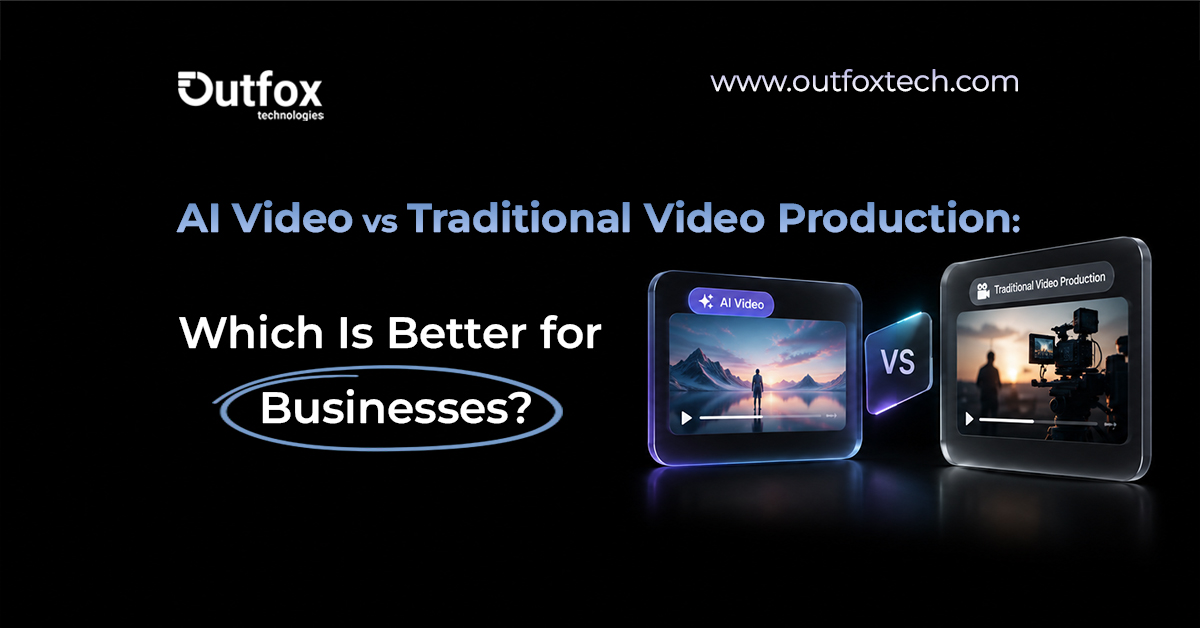
After looking at how businesses use video for different purposes, one thing becomes clear: AI video production and traditional video production solve different problems.
The better option depends on what the business wants the audience to see, feel and understand.
Sometimes, the biggest problem is simply time
A business has a weekend offer ready to go, but the promotional video needs to be created quickly.
There is no time to find a location, arrange a crew, organise lighting, shoot multiple scenes and wait for the final edit.
AI video creation can be a practical option in situations like this.
A concept can be developed quickly. Visuals can be generated or adapted. Voiceovers, animations and different versions can be explored without arranging an entirely new shoot for every idea.
For businesses that need frequent content, this can make a big difference.
But there is an important catch.
Fast production does not automatically mean good content.
A video can be produced in minutes and still fail to communicate anything useful.
The idea, script, visual direction and understanding of the audience still matter.
Then there are products that need to be seen for real
Now consider a different situation.
A restaurant is introducing a new menu and wants to turn it into engaging video content.
A clothing store has launched a new collection.
A jewellery business wants to show the details of a new design.
A hotel wants potential customers to see its rooms.
Here, real footage has an obvious advantage.
Customers can see the actual product, location, people and details.
Traditional video production still has an important place when real visuals matter.
A camera records real people, places, products, and moments as they happen.
And sometimes, that is exactly what the audience wants.
They don’t need an imagined restaurant.
They want to see your restaurant.
They don’t need an AI-generated product.
Before making a purchase, customers often want to see the product as it actually looks.
The human side of video is difficult to replace
There is another area where traditional production can make a strong difference: people.
For example, a founder could share the story behind starting the business.
A customer sharing their experience.
An employee could demonstrate how the product is made or how it works.
A chef preparing a signature dish.
These moments have small imperfections, expressions and natural interactions.
Those details can make a video feel real.
That does not mean AI cannot create human-looking content. It can.
But businesses should ask whether artificial realism is actually helping their message.
For a technology explainer, it may work perfectly.
For a customer testimonial, showing the actual customer may be far more convincing.
AI video is not necessarily the cheaper option
This is another assumption worth questioning.
It is easy to think:
AI = cheap.
Traditional production = expensive.
That is not always true.
The cost depends on what needs to be produced.
A simple AI-generated social media video may require fewer resources than a professional shoot.
But a complex AI production involving multiple revisions, visual generation, voiceovers, editing and corrections can also take considerable creative effort.
At the same time, a simple traditional shoot can sometimes be straightforward and efficient.
So instead of asking:
“Which one costs less?”
A better question is:
“Which approach gives us the right result for this particular video?”
That makes the decision much more practical for the business.
What about social media?
This is where things become interesting.
Businesses today don’t necessarily need one big video every few months.
They need content continuously.
- Instagram Reels.
- Short promotional videos.
- Educational videos.
- Product videos.
- Festival campaigns.
- Paid ad creatives.
- Quick announcements.
Different versions for different audiences.
Creating every piece through a complete traditional shoot can become difficult.
AI video creation for businesses can make the overall content production process faster and more flexible. AI can help businesses explore more ideas and produce certain types of content faster.
But traditional footage can still provide the original brand material.
The two approaches don’t have to compete.
They can support each other.
A better approach may be AI + traditional video
Imagine a business conducts one professional product shoot.
Instead of creating one video and stopping there, that footage can become the foundation for several pieces of content.
The original shoot provides authentic product visuals.
Editing creates short-form videos.
AI can then support additional concepts, animations, variations or supporting content.
Suddenly, one production can contribute to a larger video marketing strategy.
This is where AI becomes more interesting.
It does not necessarily have to replace the camera.
It also allows businesses to make better use of the photos, footage, and other content they already have.
So, when should you choose AI?
AI video production can be a good option when:
- You need content quickly
- You want to test multiple creative ideas
- You need frequent social media content
- The video does not depend heavily on real-world footage
- You need different versions of an advertisement
- Animation or generated visuals suit the concept
- You want to scale your content production
- For example, an educational technology company could use AI to explain a complicated software feature through animation rather than organising a physical shoot every time.
That can be practical and effective.
And when should you choose traditional production?
Traditional video production can be the better choice when:
- Your actual product needs to be shown
- Your location is part of the experience
- People are central to the story
- You need customer testimonials
- You are creating a brandfilm
- You want authentic product photography and video
- The physical experience is important to the audience
For a restaurant, resort, fashionbrand, manufacturer or local business, showing thereal environment can often communicate more than a generated visual.
The real question isn’t AI or traditional
This is probably the biggest lesson businesses should take from the discussion.
The question shouldn’t always be:
“Should we use AI or traditional video?”
Instead, ask:
“What does this particular video need to achieve?”
If the answer is speed, AI may be the right tool.
If the answer is authenticity, real production may be stronger.
If the answer involves both, use both.
A business shouldn’t choose technology first and then search for a problem to solve with it.
The business objective should come first.
The technology should follow.
What this means for businesses in Kerala
For businesses looking for video production in Kerala, this approach can be especially useful.
A local business may need a real product shoot for its website, while also needing several short videos for Instagram.
A technology company may need a professional founder video but also require AI-assisted explainer content.
A restaurant may need authentic food photography and video while using AI-generated creative concepts for seasonal campaigns.
There is no reason every piece of content has to follow the same production method.
The goal is to build a content system that fits the business.
Our practical takeaway
AI has changed how businesses can approach video.
But it hasn’t made traditional video production irrelevant.
And traditional production doesn’t have to reject AI either.
The smarter approach is to understand what each method does well.
Use AI when speed, flexibility and content volume matter.
Use traditional production when real people, products and places are important.
And combine them when that gives the business a better result.
Because ultimately, customers don’t care whether a video was made with a camera, AI or a combination of both.
They care about one thing:
Does the video give them a reason to stop, watch and remember the business?
That is where good video production, whether AI-assisted or traditionally produced, should begin.